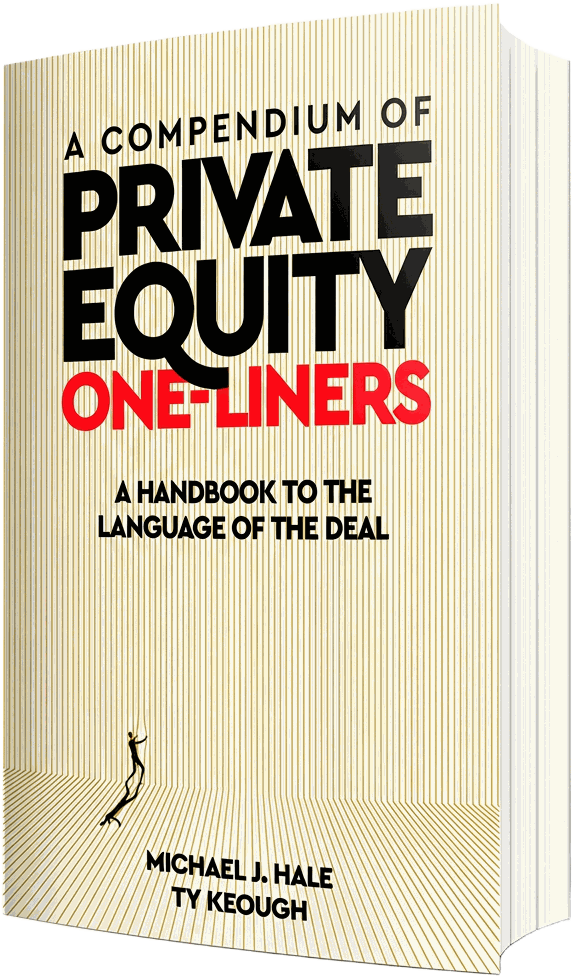
A Compendium of Private Equity One-Liners — book cover

The language of the deal.

A concise, satirical guide to the phrases that really move private equity.

Coming soonAvailable January 12, 2027

Hardcover  ·  170+ pages

Michael J. Hale  ·  Ty Keough

From inside the book

A few entries

Each entry follows the same form: a plain definition, the phrase spotted in the wild, a short commentary, and a handful of related terms.

Animals in the Jungle

Definition

A vivid PE request to show the animals in the jungle means to “map the competitive landscape, all of it.” The speaker wants to see every player, predator, and prey in a market before charging in. It’s a call for taxonomy: Who’s out there, how big they are, and who eats whom?

In the Wild

“Before we chase that platform, show me the animals in the jungle. Who’s scaled, who’s subscale, who’s hiding under a rock?”

Commentary

A phrase that mixes curiosity with a bit of self-protection. The safari language is deliberate. Before deploying capital, the partner wants to know the ecosystem: who’s hunting, who’s feeding, and who’s already dead. In practice, it’s shorthand for “Give me the full market map with logos, share, and a quick predator–prey dynamic.” If someone says it twice, expect to build a slide with animal icons.

Running the Traps

Definition

Operator slang for systematically checking all the usual channels, people, and data points to make sure nothing’s been missed. It’s diligence in motion—moving quickly through a known circuit of calls, metrics, and sanity checks before making a decision or sending up a deck.

In the Wild

“Before we finalize the forecast, I’m running the traps with sales ops and finance.”

Commentary

Efficient, not glamorous. “Running the traps” means you’re thorough without overcomplicating; it’s the opposite of “boiling the ocean.” It signals institutional muscle memory: You know the system, you know who to call, and you can flush out bad assumptions fast. It’s the PE version of checking the perimeter before declaring “all clear.”

Love Letter

Definition

A deceptively named early-morning email—usually from an operating partner or sponsor—that detonates across inboxes with phrases like “Help me understand . . .” or “This can’t be right.” Tone: restrained fury wrapped in perfect punctuation. Purpose: to reassert control, reset urgency, and ensure no one on the West Coast sleeps past 5 a.m.

In the Wild

“Woke up to a love letter from ops. Apparently, EBITDA doesn’t grow by feelings alone.”

Commentary

The irony’s the point: There’s nothing loving about it. A love letter is the PE equivalent of a drive-by performance review—equal parts accountability and theater. Veterans know to read for verbs (“own,” “reconcile,” “tighten”) and respond with data, not emotion. The only acceptable reply begins with, “We’re on it.”

BGO (Blinding Glimpse of the Obvious)

Definition

A sarcastic acronym for the moment someone presents an “insight” that’s so self-evident it barely qualifies as new information. A BGO usually arrives late in a long meeting or consulting engagement; it is framed as revelation but is met with quiet eye rolls.

In the Wild

“After three months of work, the consultants’ BGO was that pricing drives margin.”

Commentary

Used both affectionately and in exasperation. In PE, BGOs are tolerated when they finally get everyone aligned, and mocked when they just repackage common sense. The phrase lets veterans acknowledge the absurdity without derailing the discussion. Every firm has a partner who specializes in BGOs: articulate, persuasive, and always right . . . about things everyone already knew.

Consulting Math

Definition

Any back-of-the-envelope calculation presented with total confidence and zero grounding in reality. Its use is a hallmark of ex-consultants and strategy types who believe that multiplying two assumptions with decimals makes it true. Usually involves a slick table, round numbers, and a heroic CAGR.

In the Wild

“They pegged the TAM at $4.3B using classic consulting math: two slides, three decimals, zero sources.”

Commentary

A PE operator’s polite way of saying “smart-sounding nonsense.” Consulting math thrives early in diligence, when precision is impossible, but confidence is cheap. It bridges the gap between a hunch and a model—good for storytelling, bad for execution. Eventually, the associates get replaced by controllers, and consulting math gives way to state school math: less pretty, more accurate.

The authors

Michael J. Hale & Ty Keough

The book began, as most useful ones do, as private banter. For more than a decade, Michael kept a running list of the phrases that came up in deal rooms, on diligence calls, and in the polite crossfire of board meetings. Some were technical, some were euphemism, and most were both.

After long enough on the inside, as an operator, an investor, and a fellow traveler through more than a few hold periods, the list started to look less like banter and more like a field guide. Ty came in to sharpen the entries, argue over the commentary, and insist, gently, that a definition is not the same thing as a defense.

The result is a small book that takes the language of private equity at its word, and then quietly asks what that word is actually doing.

Praise

Early readers

“Reviews and endorsements will live here as they come in.”

Coming soon

Free sample

A few pages, on the house

Leave an email and we’ll send you a short selection of entries from the book.

One email. No follow-ups you didn’t ask for.

Get the book

Coming soonAvailable January 12, 2027

Available in print. Ebook to follow.